
About Me

HALO / THESIS PROJECT
Reframing Street Harassment Reporting as Civic Infrastructure
UX/UI Design
AI Exploration
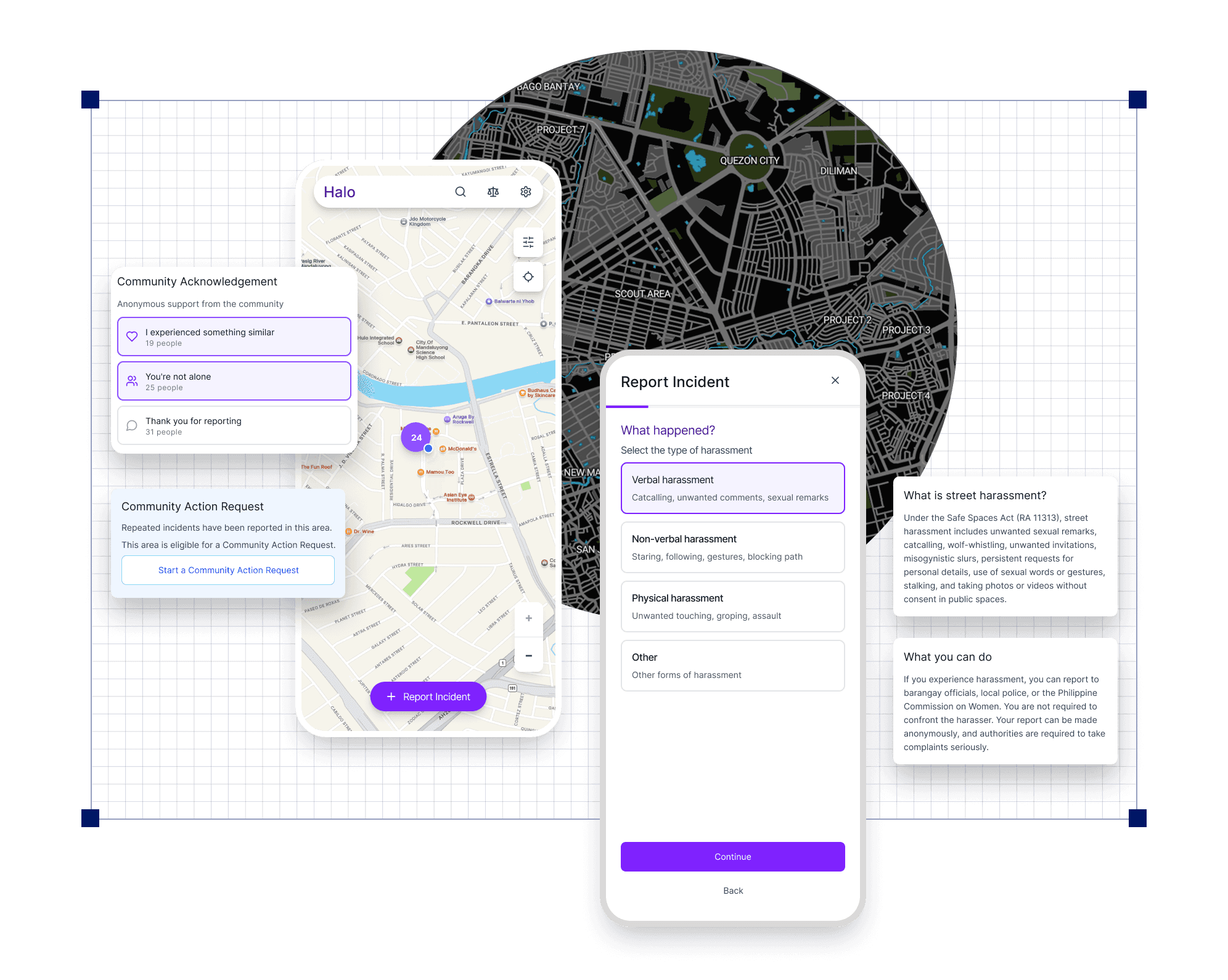
Halo is a mobile app concept that looks at street harassment as a shared, civic issue rather than an individual safety problem. Instead of offering safety guarantees or navigation, Halo focuses on making patterns of harassment visible through aggregated reports, community validation, and structured requests for systemic change.
This case study highlights Phase 2 of the project, where I deliberately reduced scope to create a more ethical, realistic, and testable product. The interactive prototype was generated using AI-assisted workflows (ChatGPT and Figma Make), with all design decisions, constraints, and ethical guardrails defined and validated by me.
PHASE 1
For context..
Halo originally started as an academic exploration into how technology could support women experiencing street harassment. Since it was a thesis I had done for my Master's, we were encouraged to design speculative products.
Early ideas explored wearable-assisted reporting, evidence capture, and safety-oriented route guidance. While these concepts aimed to empower users, they also surfaced significant concerns around privacy, accountability, and false expectations of safety.
Rather than iterating on features that introduced risk, I chose to pause and reassess the direction of the project entirely.
REFRAMING THE PROBLEM
I re-evaluated my project
As I reviewed my early concepts for Halo, I began to question the direction I was taking. While the ideas were well-intentioned, many of them positioned the user as someone responsible for managing risk:
*
by recording evidence
*
following suggested routes
*
relying on the same system to keep them safe
Looking at my own work more critically, I realized that these choices reflected a broader pattern in safety-focused products: they often shift responsibility onto individuals, imply protection they cannot guarantee, or encourage avoidance rather than accountability. In the context of street harassment, this framing felt deeply problematic.
Rather than helping people navigate perceived danger, I began to see a stronger opportunity in making recurring harassment visible in a way that respected privacy, avoided false assurances, and acknowledged the collective nature of the issue. This led to a new guiding question:
How might recurring street harassment be made visible without exposing individuals or promising safety?
DESIGN DECISIONS
Things I changed..
Reframing the problem clarified that many safety-oriented features would introduce more risk than value, leading me to make a set of deliberate design decisions focused on reducing responsibility, exposure, and false expectations.

Aggregation over Precision
Halo surfaces aggregated incident patterns instead of exact locations to emphasize recurrence while reducing risks related to surveillance, misinterpretation, and stigma.

No Safety Guarantees
Halo avoids “safe,” “unsafe,” or alarmist language to remain informational and prevent false assurances of protection.

Acknowledgement without Social Interaction
Anonymous acknowledgements allow shared experiences to be validated without enabling comments, debate, or social exposure.

Civil Action over Individual Vigilance
When patterns recur, Halo enables Community Action Requests that shift the response from individual risk management to collective, place-based action.
PHASE 2
What I focused on next
With a clearer understanding of the risks embedded in my earlier ideas, Phase 2 became about making Halo smaller, clearer, and more responsible.
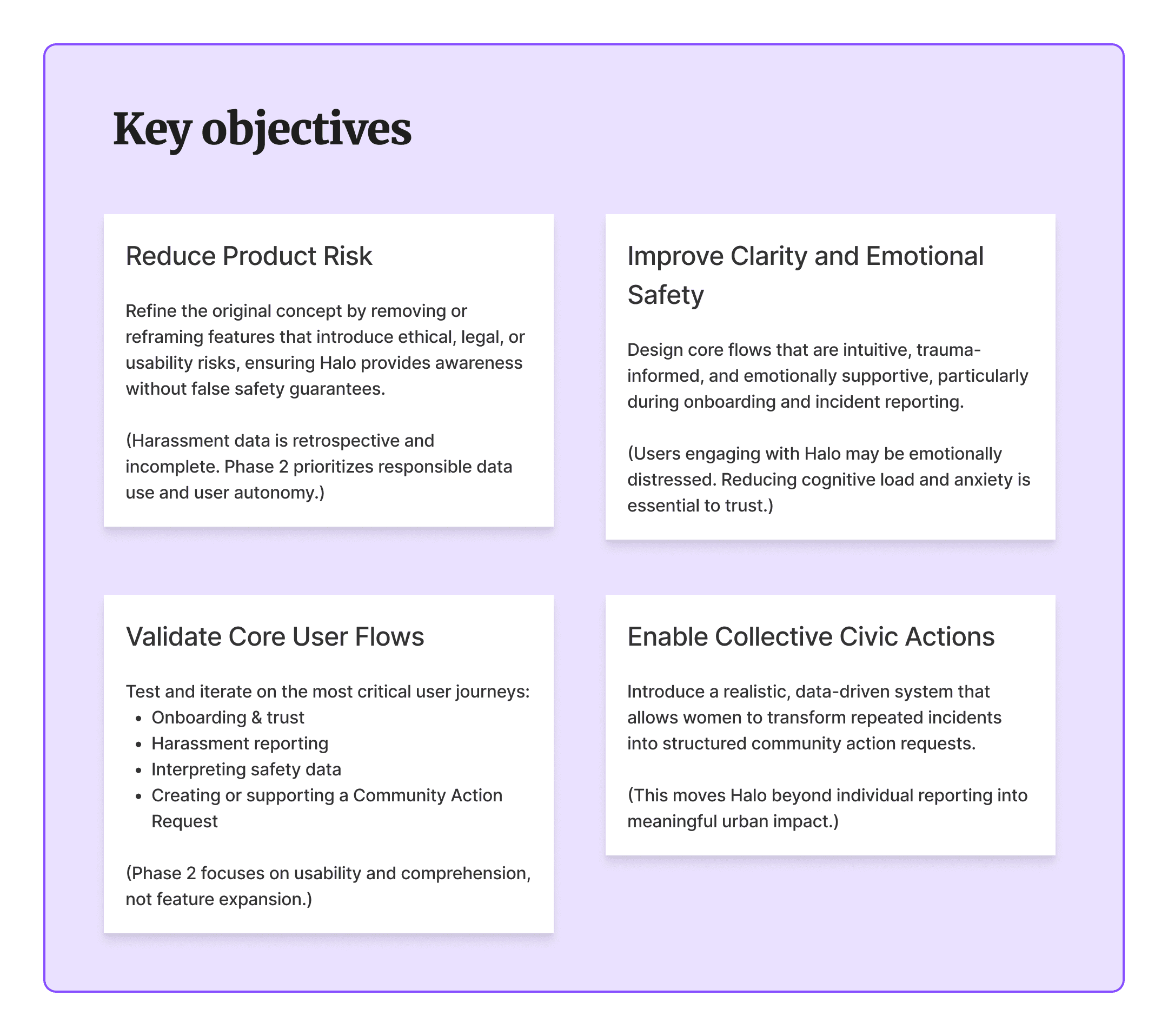
Rather than adding new functionality, I focused on restraint-driven design, where removing features was often more important than introducing them. The goal was to transition Halo from a speculative academic concept into a credible, testable product experience, while prioritizing ethical clarity and emotional safety. My four key priorities are to:
1
Reduce ethical, legal, and usability risk
3
Validate core user flows through usability testing
2
Improve clarity and emotional safety
4
Enable collective civic action without social pressure or performative behavior
These objectives gave me a clear definition of what Phase 2 needed to accomplish before I moved into screens and flows:
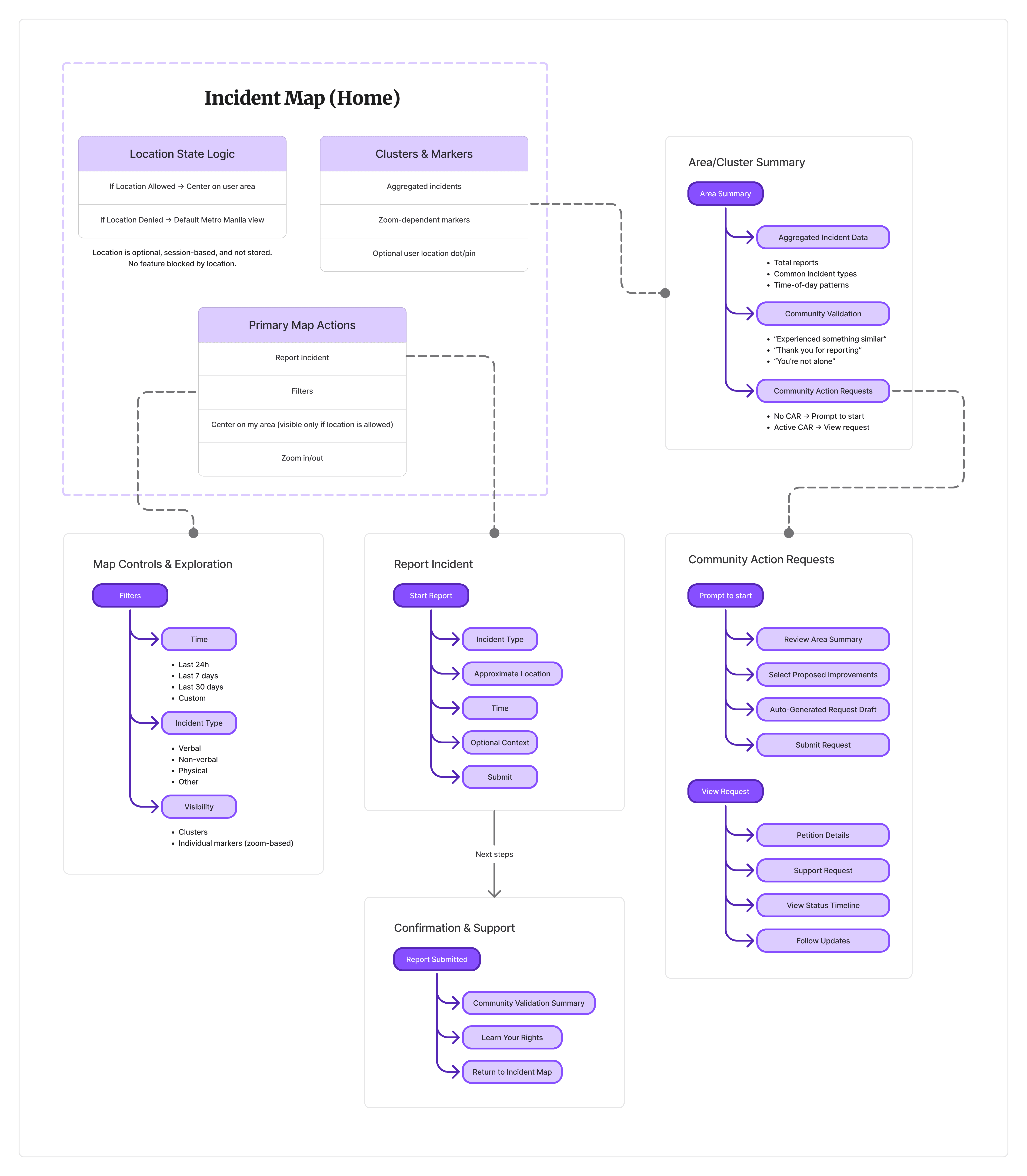
The information architecture was shaped directly by the reframed role of Halo.
I wanted critical features to remain always accessible, ungated by identity, location permissions, or prior participation. The experience is anchored to place rather than profiles, reinforcing the idea that Halo is about collective patterns, not individual activity.
The Incident Map serves as the primary entry point, supported by clear paths to reporting, area summaries, Community Action Requests, and legal education. Educational content and privacy controls are treated as core features, not secondary ones, ensuring users can understand their rights and the system itself at any point.
By keeping the structure shallow and intentional, the IA supports exploration without urgency and helps users navigate the product without feeling pressured to act.
CORE EXPERIENCE
Turning these ideas into an experience
I designed to support awareness, reflection, and civic escalation, without urgency, surveillance, or social pressure.
Incident Map
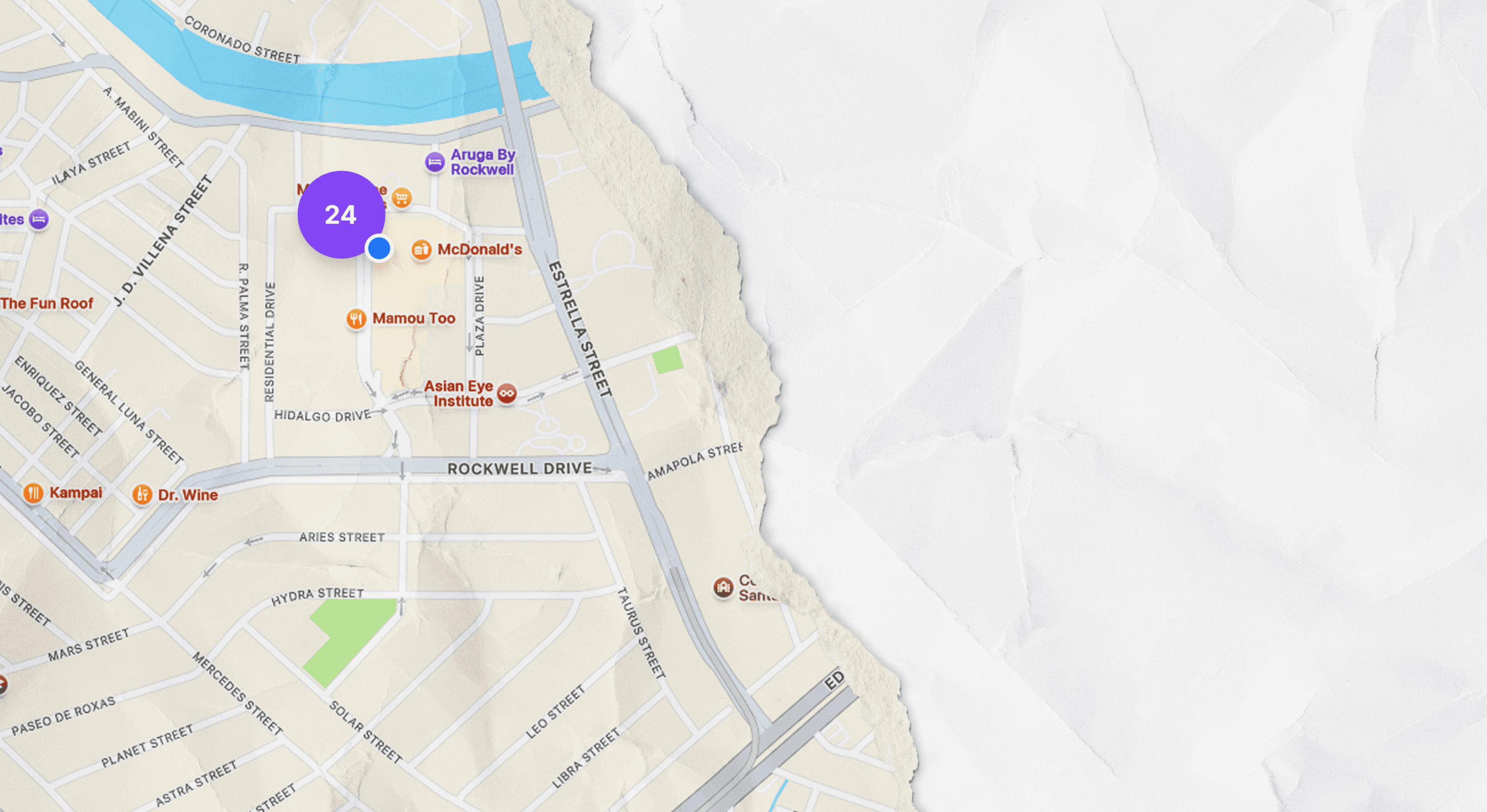
At the center of the experience is the Incident Map, which displays aggregated reports from the past 30 days.
Rather than highlighting “safe” or “unsafe” areas, the map surfaces recurring patterns at a neighborhood level, helping users understand where incidents tend to recur without exposing precise locations or individuals.
Zooming changes context, not precision, reinforcing that the data reflects patterns rather than predictions.
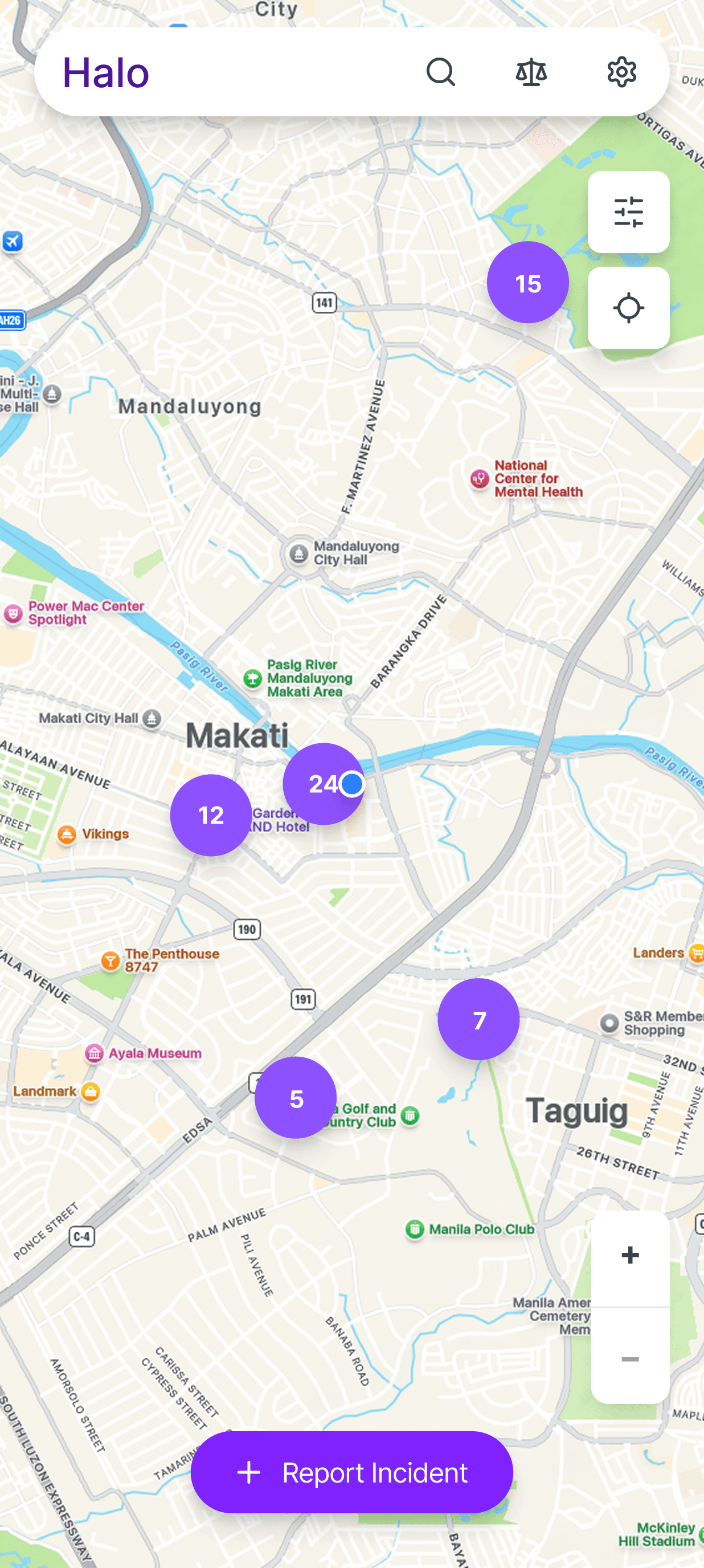
Map overview
(zoomed-out)
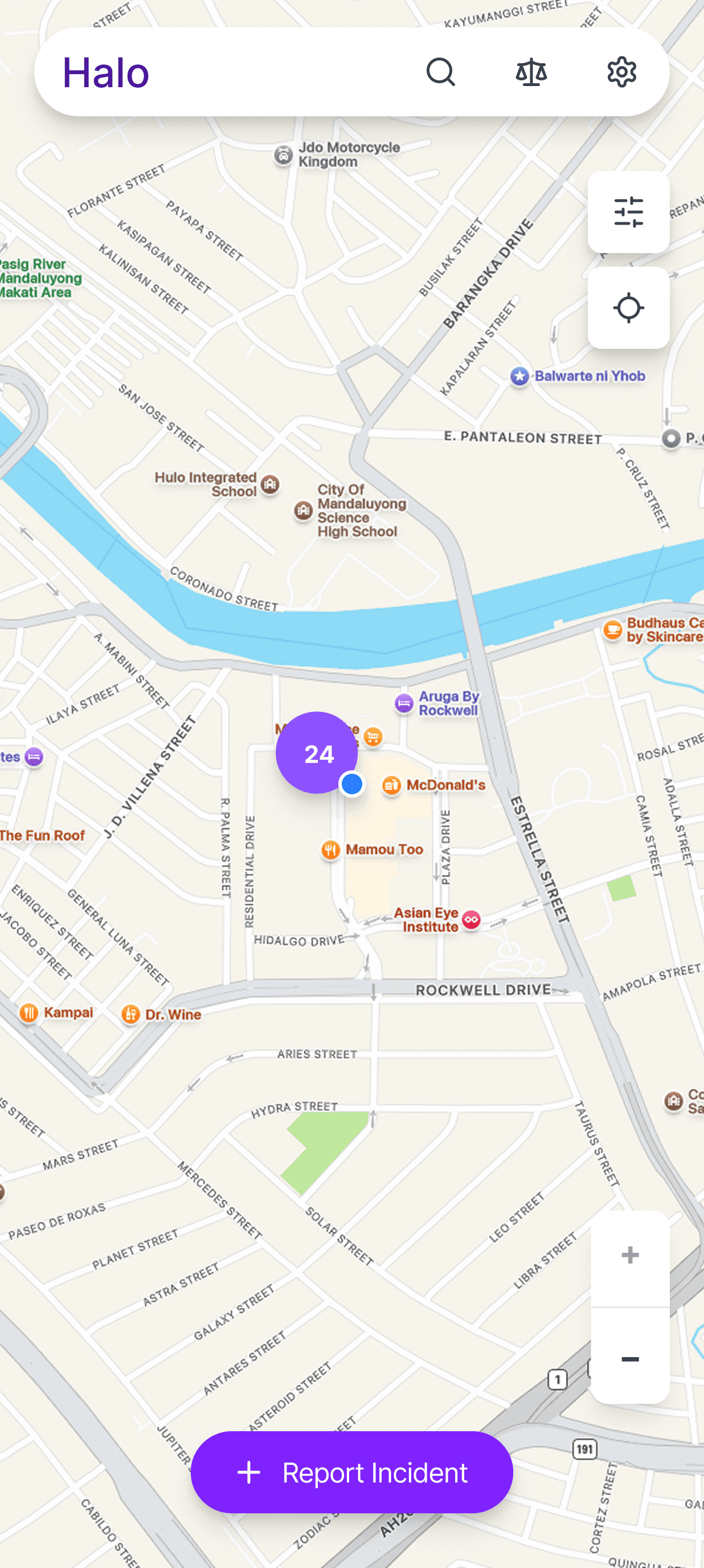
Map overview
(zoomed-in)
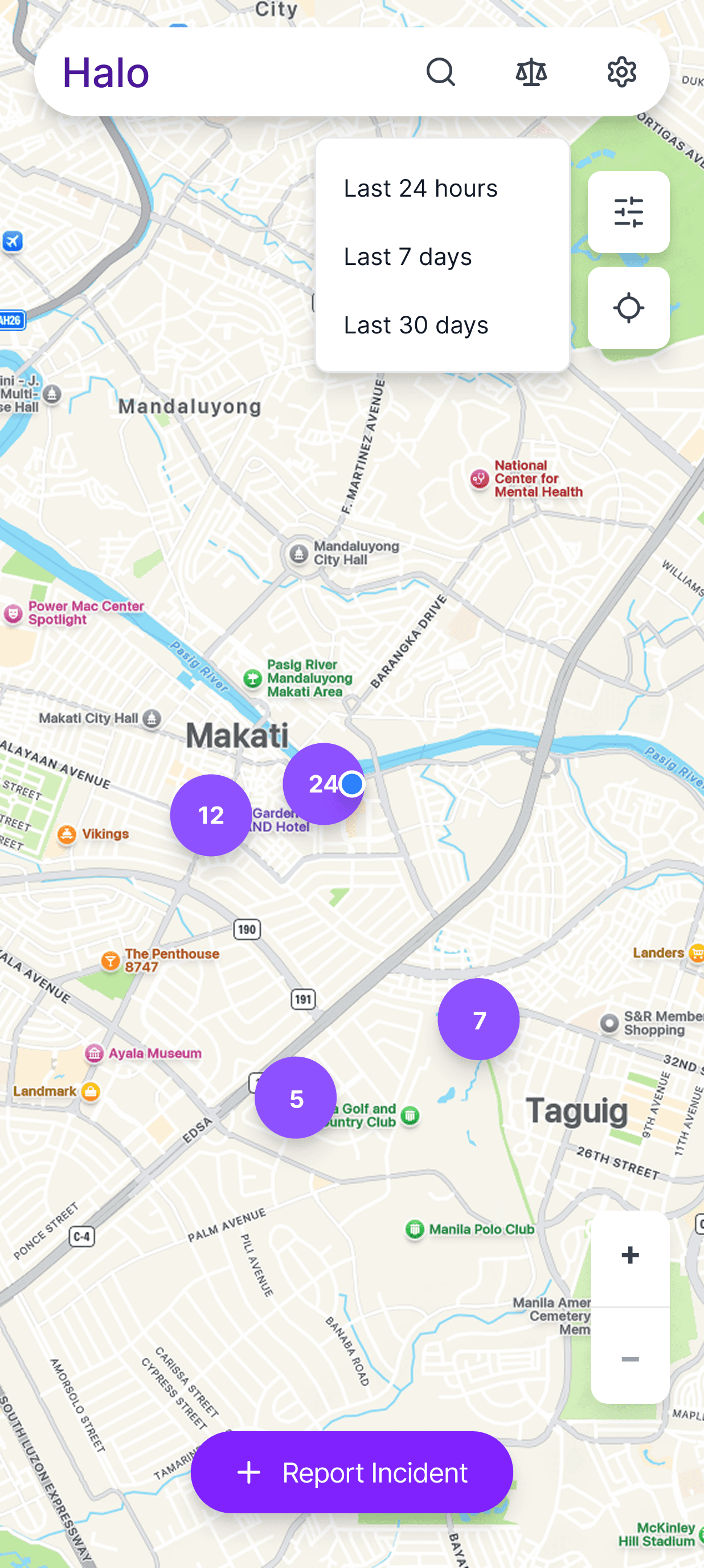
Map overview
(filter)
Area Summary
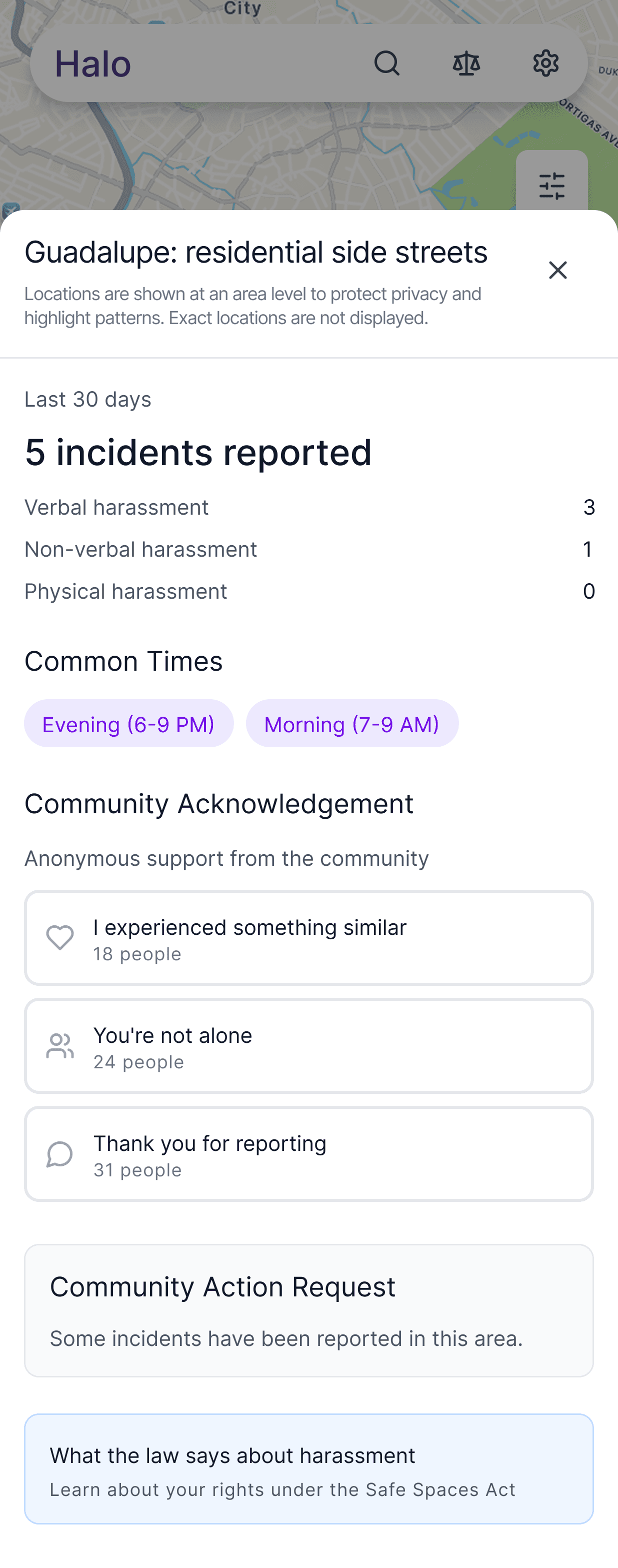
From the map, users can open an Area Summary to see a high-level breakdown of reported incidents, including common types and time patterns.
This summary provides context without judgment and clearly communicates that the absence of reports does not imply safety.
Area Summary
Acknowledgement
*
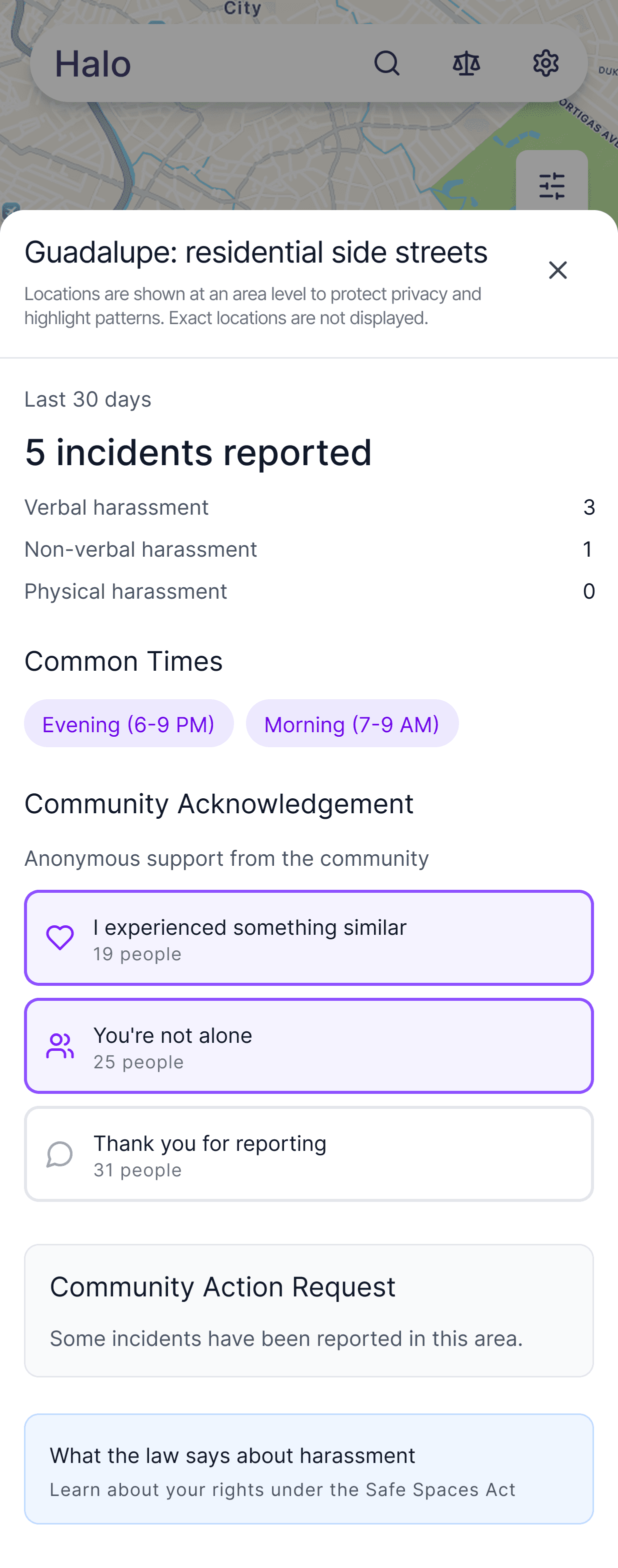
To support collective recognition without social exposure, Halo uses anonymous acknowledgements.
Users can indicate that an incident reflects an experience they’ve had in similar circumstances, allowing shared patterns to emerge without comments, debate, or performative interaction.
Reporting an incident
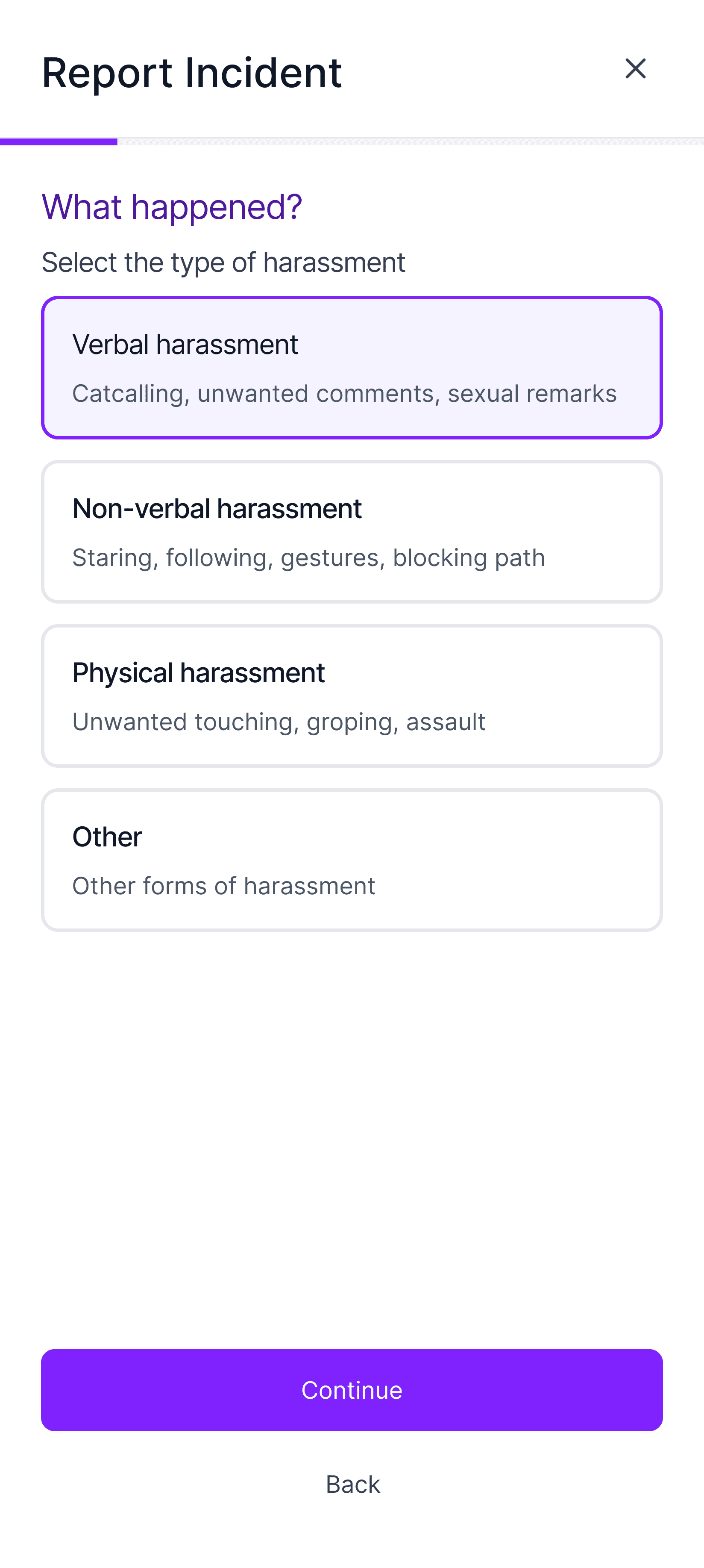
Reporting an incident is a structured, optional flow designed to minimize emotional and cognitive load.
Users are guided through selecting an incident type, approximate time and location, and optional context, without requiring photos, videos, or identity disclosure.
The goal is to capture consistent signals rather than detailed evidence.

FLOW:
INCIDENT REPORT
Community Action Requests (CAR)
When recurring incidents in an area meet internal criteria, Halo enables Community Action Requests.
These requests translate patterns into structured, place-based proposals, such as improvements to lighting or visibility, shifting the response from individual vigilance to collective, civic action.
Users can support requests and track their progress without engaging in social feeds or discussion threads.
Viewing & supporting a car

starting a car
Women's Rights
Finally, Halo includes a Know Your Rights section that provides accessible information about the Philippine Safe Spaces Act.
This content is available independently of reporting, reinforcing that education and agency are central to the experience, not conditional on participation.

FLOW:
Know your rights
VALIDATION & NEXT STEPS
Testing, learning, and iteration
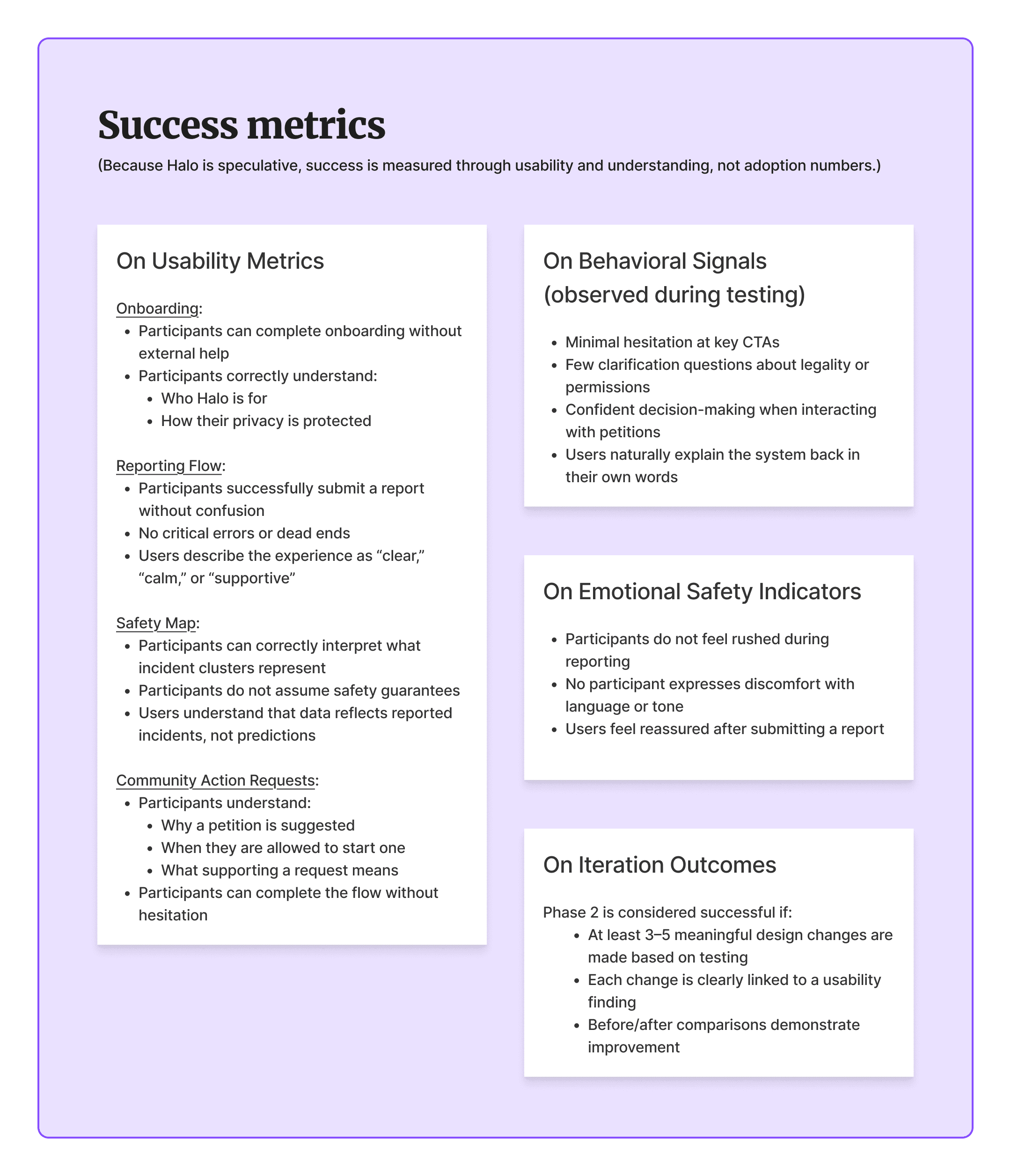
Phase 2 was designed to be testable rather than speculative. Planned usability testing focuses on onboarding clarity, reporting flow comprehension, correct interpretation of map data, and understanding when and why Community Action Requests appear.
Success is measured through user understanding, confidence, and emotional comfort, not adoption or engagement metrics. Insights from testing will inform further iteration, particularly around copy clarity and flow sequencing.
REAL LIFE USE
Sustainability without extraction
Halo is positioned as civic infrastructure rather than a consumer safety product. Potential paths for sustainability include partnerships with local governments, NGOs and women’s rights organizations, urban planning initiatives, grant-funded civic technology programs, and academic or policy research collaborations.
By remaining privacy-first and non-extractive, Halo demonstrates how digital products can support public accountability without relying on surveillance or attention-driven models.