
About Me

Klaro
Helping older adults build confidence using AI
through guided, low-risk practice.


What is Klaro?
Klaro is a responsive web app that helps older adults and AI beginners become more comfortable using AI through practical, everyday tasks.
Instead of starting with a blank chat, people learn by doing. The experience is designed to help users build confidence gradually while developing habits they can carry beyond the product itself.
My Role
Klaro is a self-initiated project and my first experience building and shipping a product with AI. I worked on everything from research and product strategy to UX, branding, and implementation.
Along the way, I also explored a new way of working with AI, moving continuously between designing, building, testing, and refining ideas until the product was ready to ship.
CONTEXT
The idea for Klaro began with a moment of feeling overwhelmed myself.
As AI tools continued to evolve at an incredible pace, I found myself wondering how people who had less exposure to digital technologies throughout their lives might experience the same changes. I thought about my parents, grandparents, and other older adults around me — many of whom are curious about AI, but unsure where to begin.
That led me to a simple question:
How might we help older adults feel more comfortable using AI?
UNDERSTANDING THE PROBLEM
The more I thought about it, the more I realized the problem wasn't really about AI.
People already have access to powerful AI tools. Many are curious about what AI can do and want to learn more.
But having access doesn't automatically make someone feel comfortable using it.
As I looked deeper into the problem, three observations stood out.
Access isn't the problem. Confidence is.
People don't necessarily need another AI tool. They need a safe place to explore, make mistakes, and gradually become more comfortable using AI in their everyday lives.
Sometimes the fear of making mistakes gets in the way.
Concerns around privacy, scams, and simply doing something wrong can discourage people from experimenting, even when they're curious.
Confidence grows through successful experiences.
People don't become confident by reading instructions. They become confident by trying, succeeding, and slowly building trust in themselves.
DESIGNING FOR CONFIDENCE
Confidence isn't built by teaching people everything.
It's built by helping them succeed one step at a time.
The more I thought about it, the more I realized that Klaro wasn't really about teaching AI. It was about helping people feel comfortable enough to keep using it. That shift in thinking led to three principles that guided the entire experience.


TEACHING CONFIDENCE THROUGH REAL TASKS
Instead of teaching AI concepts, Klaro teaches through everyday situations.
I didn't want people to learn AI by staring at a blank chat or memorizing prompt techniques. I wanted them to learn by doing things they were already familiar with.
Explain a Screenshot task
I didn't want people to learn AI by staring at a blank chat or memorizing prompt techniques. I wanted them to learn by doing things they were already familiar with.
Although the task looks simple on the surface, each step was intentionally designed to encourage small but important behaviors.
clarify what they need help with
think about what information to share
protect sensitive content
evaluate AI responses thoughtfully
reflect on what they practiced
The goal isn't simply to explain a screenshot. It's to help people feel more comfortable using AI in everyday life.

Progress should feel like learning, not gamification.
Most AI experiences stop once the answer appears.
Klaro takes one step further by helping people recognize what they've practiced and gently encouraging them to keep exploring. Instead of points, badges, or streaks, progress is framed around capabilities and recently practiced skills.
Success is measured by independence, not retention.

BUILDING KLARO WITH AI
Klaro became my first experience taking a product from concept to deployment with AI.
Before Klaro, I mostly thought about design and implementation as separate phases. I would design first, then figure out how to bring it to life later. This project felt different.
Working with AI allowed me to move continuously between designing, building, testing, and refining ideas. Something that started as a quick sketch could become a working experience within minutes, making it much easier to explore, question, and iterate on ideas.
The process became less about creating perfect deliverables upfront and more about learning through continuous experimentation.
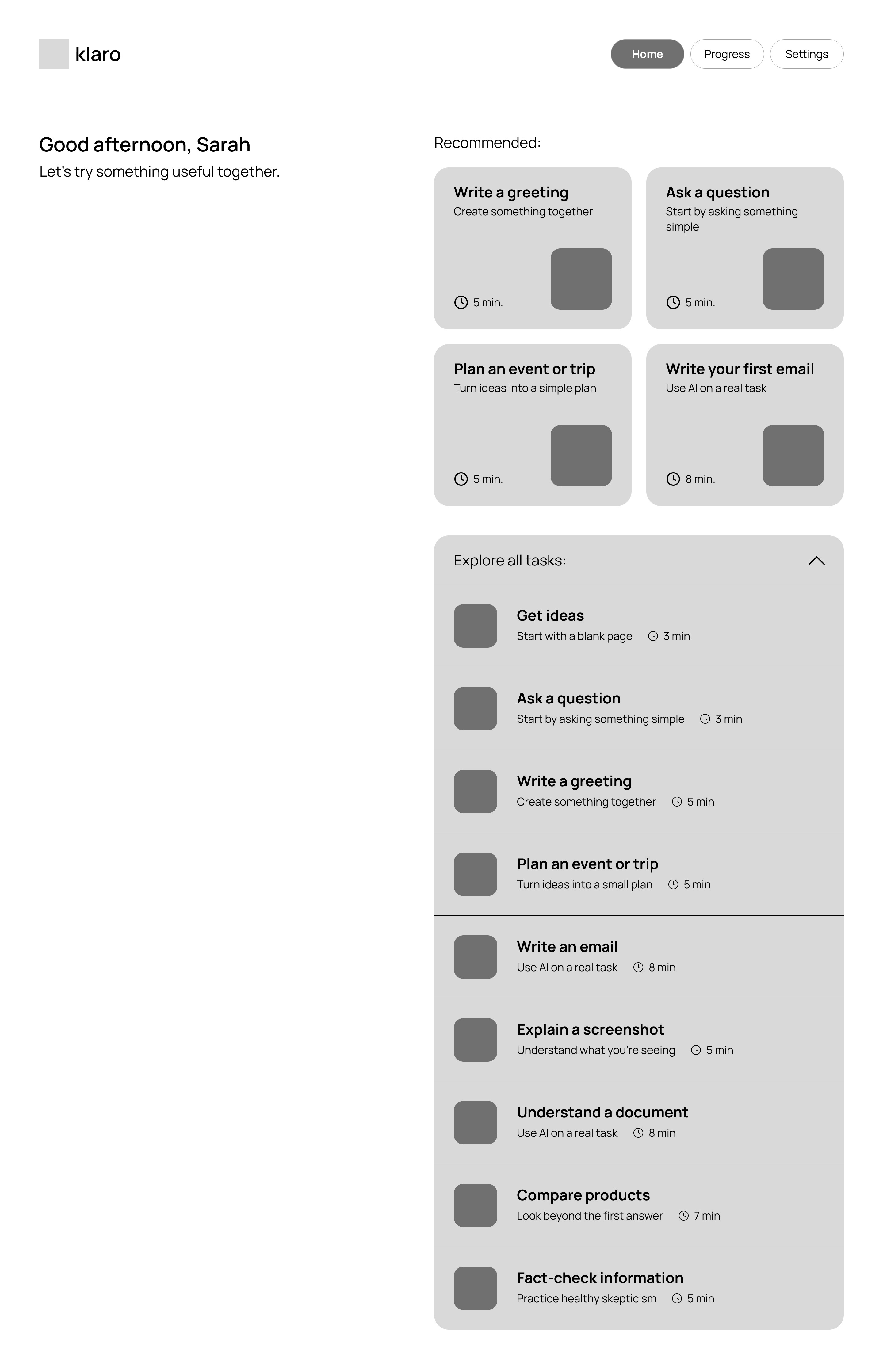
My Wireframes
Claude Explorations




Early Builds
As the product started taking shape, implementation itself became part of the design process. Many decisions only emerged after interacting with the product in the browser.


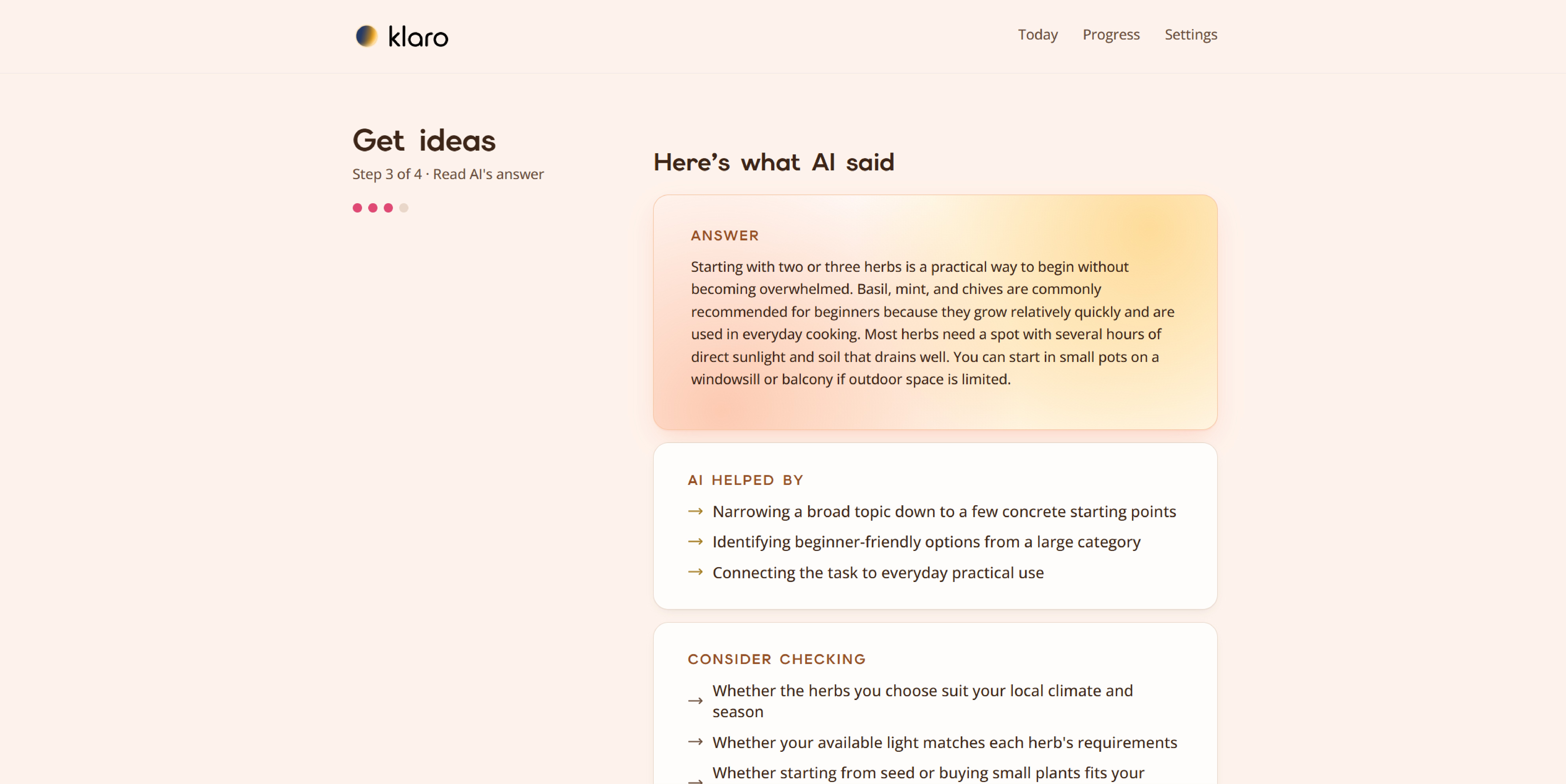
Final Product
After several rounds of iteration and refinement, Klaro evolved into a responsive MVP supporting complete learning journeys across desktop and mobile.



The speed of AI also changed my role in unexpected ways. Generating options became easier. Deciding which ideas were actually worth keeping became the real challenge. Many concepts were simplified, combined, or removed entirely as the product evolved.
AI accelerated exploration, but judgment remained a design responsibility.
OUTCOME
Klaro became my first experience taking a product from concept to deployment with AI.
I didn't try to pack Klaro with as many features as possible.
Instead, I focused on building a few experiences that directly supported the original goal of the project: helping people feel more comfortable using AI.


Guided, task-first learning
Instead of starting with a blank chat, Klaro introduces AI through practical, everyday tasks that people can immediately relate to. The goal is to lower the barrier to entry and help confidence grow gradually.
Privacy-aware interactions
Privacy isn't treated as an afterthought. Throughout the experience, users are encouraged to think about what they share and can cover sensitive information before sending anything to AI.


Capability-based progress
Most AI experiences end once the answer appears. Klaro goes one step further by helping people recognize the skills they're practicing along the way. Progress is framed around capabilities rather than points, badges, or streaks.
Responsive learning journeys
From task selection to reflection, complete learning journeys are supported across desktop and mobile devices, allowing users to interact with AI wherever they feel most comfortable.

What shipped
1 Week
From idea to deployed MVP.
0 → 1 Product
My first experience designing and shipping a product with AI.
Desktop + Mobile
Responsive experiences supporting complete learning journeys.
Anthropic API
Integrated with mock fallback support.
Live MVP
Deployed on Vercel.
What I'm most proud of isn't a specific feature. It's that the product stayed true to its original purpose.
Rather than trying to impress people with what AI can do, Klaro focuses on helping them feel comfortable enough to keep using it.